

Positive reinforcement dog training is an effective and humane way to teach new skills, improve behaviour and strengthen the bond you share with your dog.
It focuses on rewarding the behaviours you want to see more often, which reinforces that desired behaivour, rather than relying heavily on punishment or correction when your dog gets something wrong.
Reinforcement simply means that the consequence of a behaviour makes it more likely to happen again. If your dog sits and immediately receives something they value, they are more likely to sit again in the future.
The key to success is finding out what motivates your dog most and delivering that reward at the right time, which I discuss further below.
Positive reinforcement dog training involves adding something your dog values immediately after they perform a desired behaviour.
For example, you might ask your dog to sit and then reward them with a treat, praise or a favourite toy as soon as their bottom touches the ground.
The reward helps your dog understand which behaviour worked and makes them more likely to repeat it.
Positive reinforcement can be used when teaching obedience exercises, tricks and household manners, as well as when modifying unwanted behaviour.
For many dogs, food and treats are highly motivating. However, rewards can also include:
The best reward is the one your dog values at any particular moment, and it’s important to rememer that this can change form day to day, or even from one minute to the next.
Food may work well if they are always up for a treat or piece of food, but for other dogs it might only work when they are hungry – this is why trainers often suggest using your dog’s food for training or walks, rather than feeding them out of a bowl each morning or night.
For other dogs, food might not be something that gets them particularly excited. Dogs with a high prey drive for example, might be more motivated by the promise of having their ball thrown, or quick grab of the tug toy. For others, the opportunity to stop and sniff may be more valuable during a walk than a piece of food.
Paying attention to what your dog wants at the time will give your positive reinforcement dog training a greater chance of success.
Timing is critical in positive reinforcement dog training. The reward should occur immediately after the desired behaviour (or within 5 seconds) so your dog can make the direct association between the behaviour and the positive consequence (reward).
If the reward comes too late, your dog may think they are being rewarded for whatever they were doing immediately before receiving it.
A verbal marker such as “yes” or using a ‘clicker’ can help identify the precise moment your dog gets something right. The marker should then be followed by the promised reward.
Click HERE to learn about teaching your dog a ‘marker’. This is a key step in positive reinforcement dog training.
A dog instinctively is always looking to better their situation, which is why they repeat behaviours that work for them, including behaviours we may find frustrating.
Looking at, speaking to or touching a dog that jumps up, barks or whines for attention may inadvertently reward that behaviour – even if you believe you are telling them off.
Instead, consider what your dog is trying to achieve and teach them a more appropriate way to access it.
For example:
Make sure you also address any underlying causes, including boredom, anxiety, fear, frustration or a lack of physical and mental stimulation.
Click HERE to learn how we often reinforce unwanted behaviours without even realising it.
Modern, evidence-based dog training is built around reinforcing the behaviours we want, rather than continually punishing unwanted behaviour.
As a practical guide, aim for at least five or six positive interactions for every correction – and even more when your dog is in the early stages of learning.
This is not about obsessing over an exact ratio. The important thing is that your dog experiences far more guidance, encouragement and opportunities to succeed than conflict or punishment.
A reinforcement-focused approach:
If you need to interrupt an unwanted behaviour, keep the response minimal, calm and clear. Then show your dog what you would like them to do instead and reinforce that behaviour.
For example:
Your dog jumps up → you remove your attention → your dog sits → you immediately reward the sit.
Removing your attention makes jumping less rewarding, while rewarding the sit teaches your dog what they should do instead.
The most useful learning comes from reinforcing the alternative behaviour, not simply correcting the unwanted one.
If you find yourself correcting your dog more often than rewarding them, it may mean:
That is usually a training or communication problem – not a “bad dog” problem.
Rather than focusing solely on a ratio, ask yourself:
Food is convenient, easy to deliver and highly motivating for many dogs. However, how you use it can affect the success of your training.
If you feed your dog kibble or another food that can be handled safely and conveniently, consider measuring out part of their daily allowance and using it during training, walks or enrichment activities.
This allows your dog to work for some of their food while exercising their brain and body, rather than receiving every meal in a bowl.
Training before a normal mealtime can also help when food is your dog’s primary motivator. However, you should never deliberately deprive your dog of food to make them perform.
Remember to account for any food used during training when calculating your dog’s total daily intake.
Not every behaviour or environment requires the same reward.
A piece of your dog’s normal food may be enough for an easy exercise at home, while a more appealing treat may be needed when teaching something new or working around distractions.
You might create a simple reward hierarchy:
Small training treats or soft lightly cooked food pieces, are convenient to keep in your pocket during walks or around the home. The Prime100 SPD Air Dried or cut up Fresh Rolls are great, not only for a complete and balanced meal, but to use to reward your dog in training, rather than just feeding them in a bwold.
Having rewards readily available also allows you to capture naturally occurring good behaviour. If you notice your dog quietly relaxing while you work, for example, you can calmly reward them and make that behaviour more likely to occur again.
Dogs do not need a large treat every time they perform a behaviour. Very small pieces allow you to reward frequently without unnecessarily increasing their calorie intake.
Treats and other foods offered outside your dog’s complete and balanced diet should generally account for no more than 10% of their daily calorie intake.
If you use part of your dog’s measured meal allowance during training, this is different from adding extra treats on top of their usual daily food.
Positive reinforcement is particularly important during puppy training because puppies are still learning how to live in our human world.
They need clear guidance, patience and frequent opportunities to get things right. During the early teaching phase, reward your puppy every time they perform the desired behaviour so they can make the connection between their action and the reward.
Once your puppy understands the behaviour reliably, you can gradually vary how frequently you provide a food reward while continuing to acknowledge good behaviour with praise, play or other rewards.
Read more about training a puppy with positive reinforcement, including the different stages and schedules of reinforcement.
If your dog’s behaviour is driven by fear, anxiety, aggression or another complex emotional issue, seek advice from a qualified reward-based dog trainer, veterinary behaviourist or veterinarian.
Punishment may suppress warning signs without addressing the underlying cause and could make fear or aggression worse.
Behaviour that changes suddenly can also be associated with pain or illness, so arrange a veterinary examination if you notice an unexplained change in your dog’s behaviour.
Does positive reinforcement mean ignoring all bad behaviour?
No. You still need to manage unwanted behaviour, maintain appropriate boundaries and keep everyone safe. The aim is to calmly interrupt or prevent the unwanted behaviour, then teach and reinforce a more appropriate alternative. However, the old school ‘alpha’ based training is no longer supported by science, and can do more harm than good. Learn more about that HERE.
Is positive reinforcement the same as bribing a dog?
No. A bribe is shown before a behaviour to persuade the dog to respond. In positive reinforcement training, the reward is delivered after the desired behaviour. Food may initially be used as a lure when teaching a new movement, but it should then be faded so the dog responds to the cue rather than needing to see the treat first.
Do I have to give my dog a treat every time?
Reward every correct response when your dog is first learning a behaviour. Once the behaviour is understood and reliable, you can gradually move to an intermittent schedule and vary the rewards you use.
Continue to acknowledge good behaviour throughout your dog’s life, even if you do not provide food every time.
Many owners stop acknowledging and rewarding their dog once they have undertaken their initial training. However, it is important to remember how you would respond if you went to work and never got paid again.
If your pay schedule varied, but you still got paid for a good job done, you’d continue working. But if you continued to do the right thing, but never got paid, at some point you would lose interest, or stop going at all. This is the same for our dogs – always keep them motivated to do the right thing!
What if my dog is not motivated by food?
Try another reward, such as a favourite toy, a game, praise, affection or access to an activity your dog enjoys. Also consider whether the environment is too distracting or your dog is feeling stressed, tired, unwell or already full.
Can praise be used instead of treats?
Yes, provided your dog finds praise rewarding enough for the task and environment. Praise may work well for familiar behaviours, while food, play or another higher-value reward may be needed when teaching something new or working around distractions.
About the Author: Lara Shannon is a certified dog behaviourist and trainer, pet food nutrition specialist, Executive Producer and Host of Pooches at Play on Channel 10 and editor of Poochesatplay.com. Lara also runs her own dog training business in Melbourne’s Bayside area and is the author of World of Dogs and Eat, Play, Love (Your Dog).
Calm an Anxious Dog at the Vet or Groomer


Environmental enrichment for dogs
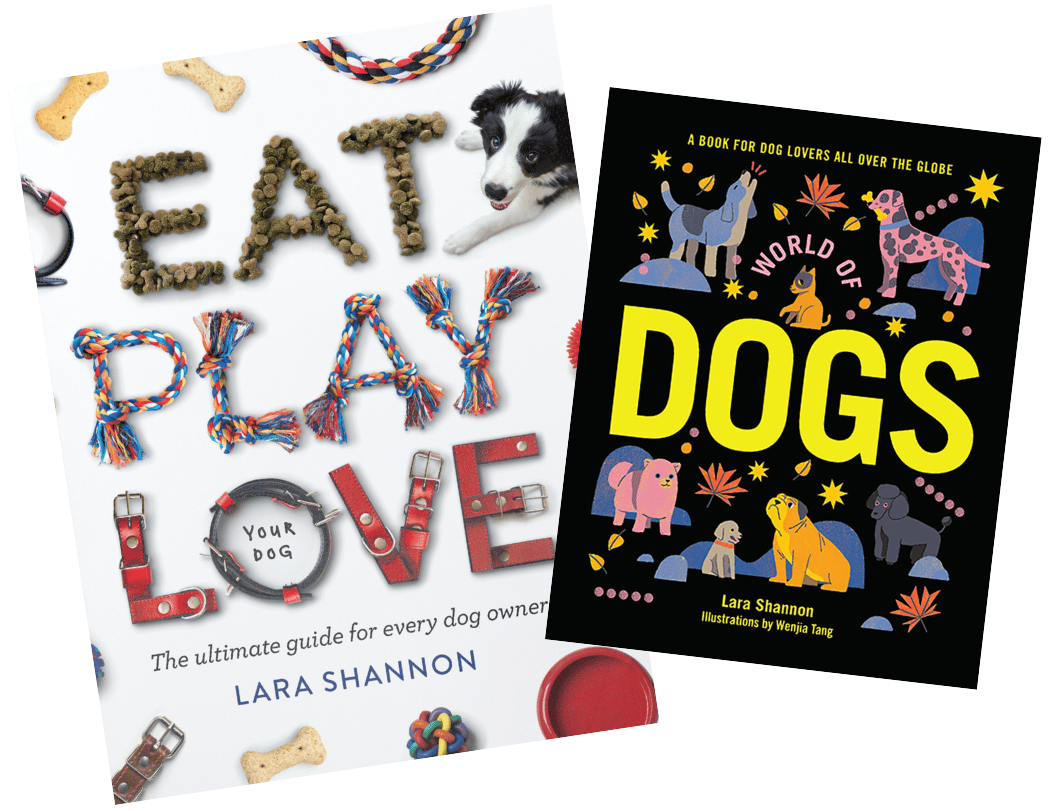
Get your paws on Lara Shannon’s best selling books ‘Eat, Play, Love (your dog) and World of Dogs.
Available in Australia, USA, UK and Canada.